
MUSIC
Tracklist
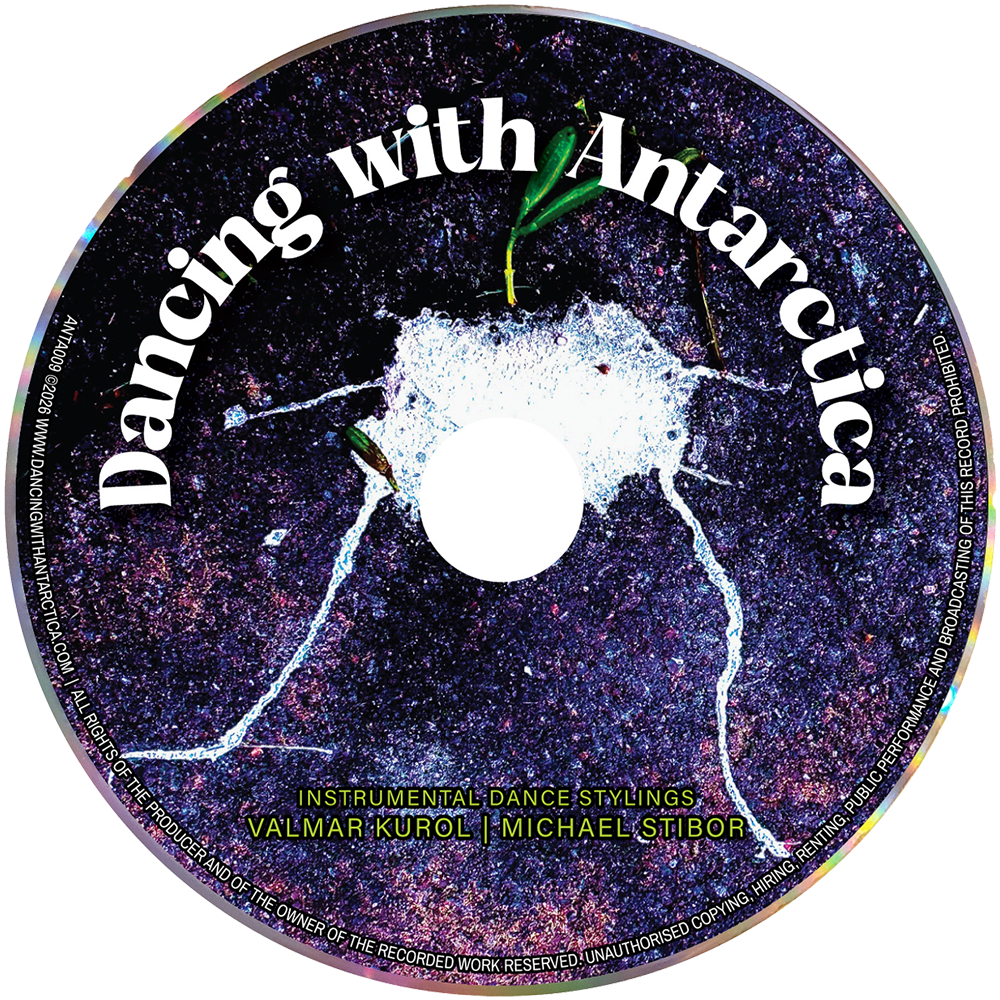
Instrumental Dance Stylings
Dancing with Antarctica
Buy Album on:
In 2018, the first dance-film reportedly made in Antarctica was of a New Zealand ballerina performing a modern dance near New Zealand’s Scott Base near the Ross Sea. The 5-minute performance was done to celebrate Antarctica and to draw attention to the crisis of climate change. In 2022, a Canadian DJ and music producer played a set of electronic dance music on a recently launched state-of-the-art tourist vessel, in Paradise Bay, on the Antarctic Peninsula, aimed at raising funds for climate change awareness. This was followed in 2023 by two American DJs and producers with a 90-minute livestream dance music set on the helipad deck of another new tourist vessel in the Antarctic Peninsula area, to raise awareness and funds for ocean conservancy. In January 2025, a French ballerina in a white tutu danced a routine en pointe on top of a French luxury cruise ship’s bulbous bow in the waters of the Antarctic Peninsula. A short video of this quickly gathered millions of internet views. In the fall of 2025, a luxury cruise ship line was advertising an early 2026 voyage as a “South America & Antarctica Dance Cruise.”
Whatever your opinions on the effectiveness of these recent unusual dance activities to garner attention for causes and awareness for the continent by these cool artist-entrepreneurs and media-savvy cruise operators, their dance-related activities led us to consider the challenge of doing dance tracks to illustrate various aspects of Antarctica. Eventually, this idea consumed the entire album.
1. Trip Hopping with Icebergs
Trip hop is a loose blend of atmospheric, psychedelic electronica that emerged in the late1980s and 90s in the U.K., with elements of hip hop, cool jazz, funk and soul.
Our track offers a downtempo look at an iceberg parade, one of the enriching experiences of discovery that may be enjoyed by all fortunate shipboard visitors to Antarctica.
2. Disco on Deck
Disco is a style of dance music that developed in urban clubs during the 1970s. It was based on African, Latin and Italian-American influences, later developed further by European artists, as a counter-reaction to the dominance of rock music.
Not wanting to miss out on the disco experience, we contribute our own track to this body of music that has also migrated to Antarctica, whether played on the deck of a cruise ship or in any of the bars existing at larger research stations.
3. Ballerina on a Red Bulbous Bow
The French ballerina, previously mentioned, performed her dance on the bulbous bow of a new cruise ship. This is a large protruding extension of the lower bow of a ship, below the waterline, intended to reduce the drag of water around the ship and to help reduce pitching. She did not have much surface area to work on and was just a few feet above the water level, dancing in cold Antarctic air.
What could be more fitting than a quiet, stately waltz to accompany such elegant athleticism on cold, pitching steel, so close to the coldest water imaginable?
4. Irish Icedance
Men of Irish heritage made significant contributions to Antarctic exploration in the early 1900s. The best known may be Ernest Shackleton, extraordinary leader of the Endurance Expedition. Tom Crean, a member of both Robert Scott’s and Shackleton’s expeditions, was known for outstanding courage and toughness. Another explorer was Francis Crozier, captain of HMS Terror, which was part of James Clark Ross’ Antarctic expedition in 1839-43. Crozier and his ship were later part of the lost Franklin Expedition that was searching for the Northwest Passage in the Canadian Arctic. Another noted Irish ship captain was Edward Bransfield, after whom the Bransfield Strait in Antarctica was named. Bransfield was thought to have made the first sighting of the Antarctic Peninsula in 1820, although that honour is now credited to a Baltic German-Estonian, Captain Fabian von Bellingshausen. He was in command of a Russian expedition in the same area and sighted land only a few days before Bransfield.
Our track presents a panorama of Irish-style music in memory of those explorers of old, and for those inclined to step dance around the deck of their modern Antarctic cruise ships.
5. When Cows Went to Antarctica
American naval officer and polar explorer Richard Byrd undertook his second Antarctic expedition over 1933-35. It is well-known for the 5-month period he spent in isolation at a remote weather station and was nearly killed by carbon monoxide poisoning. The expedition is less known for the three Guernsey cows that were transported to a specially-built barn at the main base, ostensibly to provide milk, but more practically, for publicity reasons. On the journey there, one of the cows gave birth to a bull cow, so then there were four. However, during their stay, one cow developed frostbite and had to be put down. The remaining three cows returned to the U.S. and became media darlings.
Our track offers some far-southern hospitality with a rousing barn dance for these historic cows and their polar cowboys.
6. Warming Up with Bossa Nova
Recent satellite photographs of Antarctica have shown that parts of East Antarctica gained ice mass over 2021-22, which was expected to continue for 2023. This is thought to be temporary, however, the result of increased rain and snow in the atmosphere over the continent from global atmospheric warming, and does not make up for decades of increasing ice loss. The expected longer term trend is not good, with less ice as grounded glaciers and ice shelves continue to melt, increasing the flow of inland ice to the sea. Antarctic sea ice reached near-record lows again in 2025.
Bossa nova is a relaxed swaying musical style that evolved from Brazilian samba rhythms and jazz. Brazil has maintained a permanent scientific base on King George Island, off the tip of the Antarctic Peninsula, since 1984. This is one of the warmest, most accessible and visited parts of Antarctica.
Our bossa nova track swings and sways in a warming world, with the hope that ice and music don’t disappear as a result of humanity’s carbon use excesses.
7. Last Call at the Grand Ice Ballroom
A grand ballroom is a large elegant room used for events such as conferences, weddings and formal galas. The East Antarctic Ice Sheet is the largest ice sheet on earth, averaging 1.4 miles in thickness and comprising 73% of Antarctica’s land mass. This is larger than any of the areas of United States, Canada or China. It is the subject of much study as to its ice-mass losses or gains and how this may affect sea levels in the distant future. Apart from a few scientific bases, the area is a desolate windy desert of ice.
In our country-rock waltz track we imagine the Antarctic Ice Sheet as a giant ballroom for a marathon dance with two competing couples left, one couple advocating the urgency to control global warming, the other couple denying that anything about the climate is changing. Eventually, time will run out and the Ice Sheet will announce the outcome.
8. Sizing Up Clouds
In 1966, songwriter Joni Mitchell wrote that “clouds got in my way” and that “I really don’t know clouds at all.” Observations and study of Antarctic cloud distributions are limited by difficult access to a remote, harsh world. A scientific report released in 2025 reported that clouds have an important effect on warming on the Antarctic Peninsula and on the Southern Ocean, due to their interactions with infrared and solar radiation. The result is an overall cooling in the summer and warming in the winter. The study examined two widely used models and found that one of them notably underestimated the part of the year during which clouds cause warming. This is just a small example of how limited access to an isolated area can lead to biases and inaccuracies in climate and weather forecasting models. This can impact knowledge of the true extent of global warming, which may be greater than imagined.
Our track imagines the sensations of contemporary free-form dancing on soft, fluffy clouds.
9. Isolation Blues
Antarctic blues can refer to various shades of blue in icebergs and ice, as well as being a description of various unpleasant psychological effects from social isolation and darkness that may be felt by researchers and support staff during long wintering-over stretches.
Slow blues is a type of expressive, earthy social dance developed from African-American traditions and blues music.
With this track, we offer our own version of a slow blues dance in the distant south.
Credits
Musical compositions by Valmar Kurol & Michael Stibor, ©2026
Synthesizer & programming, guitars, arrangements and mixing by Michael Stibor
Additional arrangements by Valmar Kurol
Mastered by Richard Addison, Trillium Mastering (Montreal, Canada) www.trilliumsound.com
Photographs and track notes by Valmar Kurol
Album graphics by Michael Valcenat
Produced by Valmar Kurol
© 2026 Valmar Kurol & Michael Stibor